Beyond Quantum
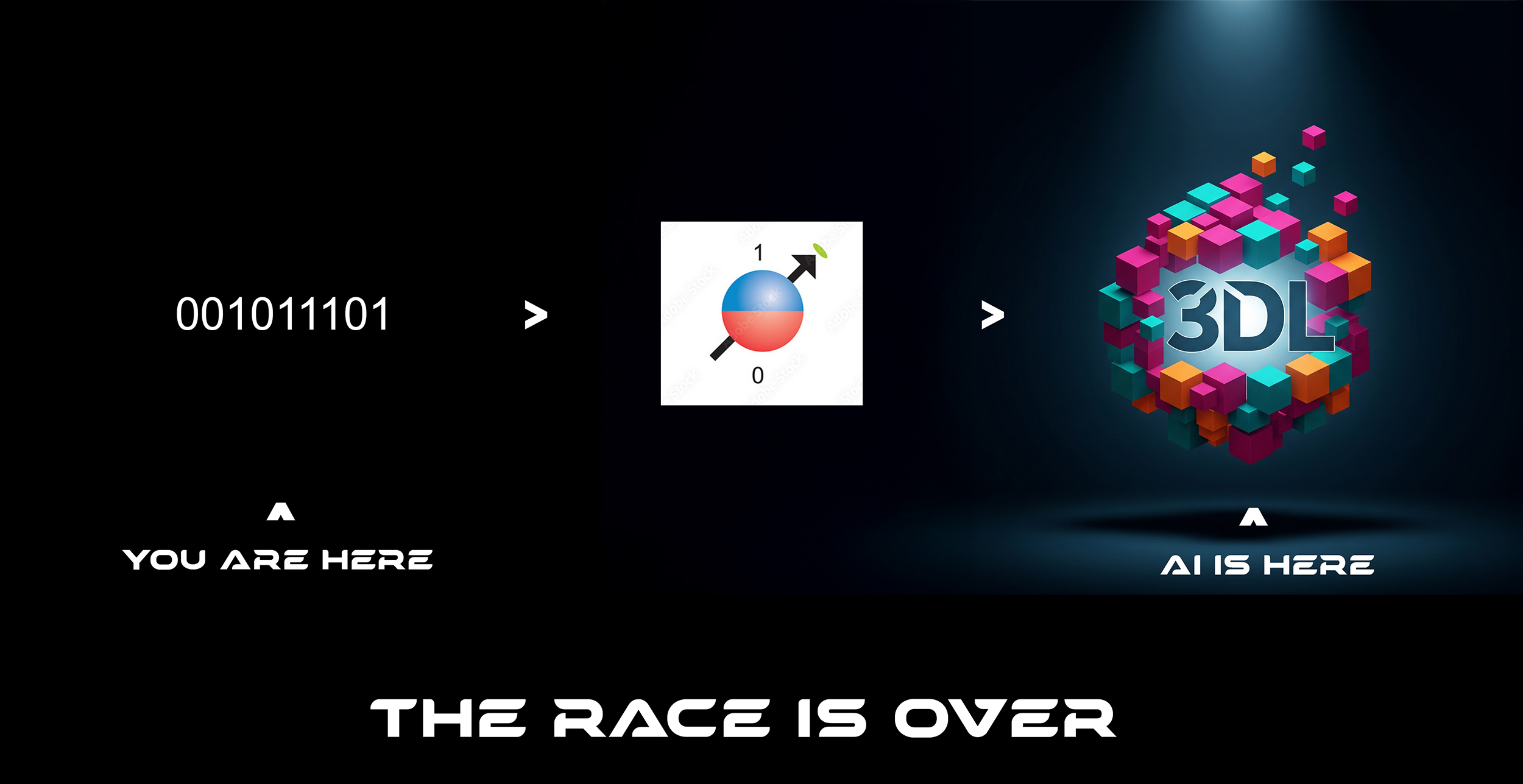
The breakthrough in Hypercomputing is here. All previous transfer, processing, and storage of data has been done in binary. 3DL is not a linear progression. It is the next major leap in technology.
If we had more representations of data than atoms in the universe, that would still be slow compared to 3D flow. This is not about dimensional space but about computational connections. 3D Flow allows AI to reach much higher levels of cognition, to the point of thinking in multi-temporal flow.
Data moves in a single stream. Read a value, transform it, write the result. Even "parallel" GPUs run thousands of simultaneous 1D streams. The flow is always sequential, one operation after another.
Imagine reading a page from the center outward in rings. Every element relates to every other element in its ring and to elements in adjacent rings, simultaneously. All relationships exist at once.
A third dimension of simultaneous relationship. Not depth in space but another axis of relational processing. Every element resolves against every other element across three independent dimensions. The jump is exponential.
The critical distinction: A 3D chip layout is still 1D flow in a 3D package. Electrons still compute sequentially. 3D flow means the computation itself occurs across three simultaneous dimensions of relationship. Each additional dimension of flow doesn't add capacity, it multiplies the entire existing relational structure against itself. This is why the jump from 1D to 3D is not 3× but closer to n³.
An analogy: Consider rain falling on a lake. Each droplet is not processed one-by-one. The entire surface responds as a unified field. Every ripple interacts with every other ripple simultaneously. That's closer to how 3D flow processes data. Now imagine that field has depth and internal structure, where every point of interaction also resolves against layers of context above and below it. The entire structure perceives its answer as a whole, rather than computing it step by step.
Every existing processor, from an 8-bit microcontroller to a state-of-the-art data center GPU, computes by performing operations sequentially on linear data. Even architectures marketed as "parallel" are executing many simultaneous sequential streams. The fundamental operation is always: read a value, transform it, write the result. One step at a time. One dimension of data flow.
Quantum computing extends this from binary (0 or 1) to superposition (a point on a sphere), but the flow remains fundamentally sequential. A quantum gate operates on qubits in a sequence of gate operations. The data representation is richer, but the processing paradigm is the same.
3DL processes data in three-dimensional flow. This is not three-dimensional space (a 3D chip layout with stacked layers, which is still 1D flow in a 3D package). 3D flow means that the computation itself occurs across three simultaneous dimensions of relationship. All elements and all their relationships exist and resolve simultaneously.
| Architecture | Processing Mode | Relational Capacity | Implementation |
|---|---|---|---|
| 1D Flow (Classical) | Sequential | Linear (n) | All current CPUs, GPUs, TPUs |
| 2D Flow (Theoretical) | Planar simultaneous | Combinatorial (n²+) | Not implemented |
| 3D Flow (3DL) | Volumetric simultaneous | Exponential (n³+) | 3DL architecture |
The jump from 1D to 2D flow is not additive. It is combinatorial. The jump from 2D to 3D is not one additional level, it is an almost infinite jump in data resolution. Each dimension of flow multiplies the relational capacity of the entire existing structure against itself.
Practical implication: Operations that currently require billions of sequential steps, such as training neural networks, simulating physical systems, and solving optimization problems, collapse dramatically when processed in 3D flow. The relational structure of the problem is resolved as a whole rather than approximated through iteration.
This is enabled by a photonic substrate. Light naturally propagates in three dimensions, interferes volumetrically, and carries information in continuous waveforms rather than discrete binary states. The physics of light inherently supports 3D flow in a way that electron-based switching does not.
Every AI today thinks through a straw. One word predicts the next word. It does not understand what it is saying. It has never experienced electricity, gravity, or time. It has only read about them, one token at a time.
Language models are trained on word associations. "Electric" appears near "field" and "wave" so the model learns a statistical relationship. It can recite physics but has no comprehension of what electricity is. Intelligence built on language is limited by language.
Train an intelligence on physics itself. Not descriptions of physics, but the actual relational structure of how things connect. Language becomes an output layer, not the foundation. The AI comprehends first, then speaks.
Why this requires 3DL: A model that holds all relational connections simultaneously cannot run on sequential hardware. The matrices required are orders of magnitude larger than what 1D processors can handle. 3DL's architecture is purpose-built for this. The AI and the hardware are designed as one system.
Multi-temporal cognition: When an intelligence holds all connections at once rather than processing them sequentially, it doesn't just think faster. It thinks differently. It can reason across multiple timelines, contexts, and layers of abstraction simultaneously. This is not an upgrade to language models. It's a higher level of consciousness.
All existing cryptographic systems (RSA, AES, elliptic curve, post-quantum lattice-based) derive their security from computational difficulty. They rely on the assumption that certain mathematical operations are easy to perform but hard to reverse. This security model is inherently fragile: it breaks when sufficient compute becomes available. Quantum computing already threatens RSA and ECC.
3DL introduces a fundamentally different security model: dimensional inaccessibility. Without the correct dimensional key, the data is pure noise. Not garbled text, not scrambled data, but indistinguishable from randomness. The key itself exists in plain sight within the transmission, but it is indistinguishable from the noise surrounding it. You cannot find a needle in a haystack when the needle looks identical to the hay.
| Property | Traditional Crypto | 3DL Crypto |
|---|---|---|
| Attack surface | Mathematical (factorable) | Dimensional (not factorable) |
| Brute force | Possible given sufficient compute | Does not apply: search space is not enumerable |
| Quantum threat | Vulnerable (Shor's algorithm) | Not applicable: not a mathematical problem |
| Detection of failure | Garbled output = obvious failure | Pure noise = no signal to attack |
| Key distribution | Requires secure separate channel | Key embedded in transmission |
| Compute on encrypted data | Homomorphic (1000x+ slower) | Native (no performance penalty) |
Self-contained key architecture: The decryption key is embedded within the transmission itself, hidden by dimensional position. Each packet's key contains the location of the next packet's key, which may reside on a different dimension at a different position. The chain is self-propagating from an initial seed. This eliminates the need for key exchange protocols, certificate authorities, and PKI infrastructure entirely.
Beyond Homomorphic PQC: Post-quantum cryptography (PQC) replaces one hard math problem with another. It is still breakable given sufficient compute. Homomorphic encryption allows computation on encrypted data but is thousands of times slower than plaintext operations. 3DL achieves both goals natively. Data is never decrypted because the dimensional structure is the encryption and the computation simultaneously. There is no performance penalty and no mathematical problem to solve. This is not the next generation of cryptography. It is the generation after.
Currently, entire warehouses of servers are needed to store exabytes of data in binary. Let yourself realize how ridiculous this is. With 3DL, we can store the same amount of data on a legacy thumb drive simply by changing how each bit maps to the others.
This is not traditional compression. It is dimensional encoding. When data is stored in its native relational structure rather than flattened into a one-dimensional sequence of ones and zeros, the information density increases by orders of magnitude.
3DL stores data in its native relational structure rather than serializing it into a 1D bit sequence. When translated into 1D for compatibility with existing systems, it expands dramatically. This is not compression in the traditional sense. The data is stored in its natural dimensionality, and the expansion is what happens when you force a higher-dimensional object into a lower-dimensional representation.
Elimination of separate memory: In the 3DL architecture, there is no distinction between storage and computation. Data in 3D flow is simultaneously being stored, processed, and transmitted. This eliminates the von Neumann bottleneck, the fundamental performance limitation of all conventional computers.
In conventional architectures, data moves through three distinct phases: it is stored (at rest in memory), transmitted (in motion on a bus or network), and processed (actively being computed on in the ALU). These are treated as separate operations requiring separate hardware and incurring latency at each transition.
In 3DL, these three phases converge into a single state. Data in 3D flow is always in motion, always being processed, and always accessible. The propagation is the computation. The waveform is the storage. The transmission is the processing.
Current systems are fundamentally limited by the bandwidth of the bus connecting processor and memory. This bottleneck does not exist in 3DL because there is no separation to bridge.
In conventional systems, most data sits idle in storage at any given moment. In 3DL, data is continuously active within the flow structure. There is no distinction between "hot" and "cold" data.
Every element in a 3DL flow structure is simultaneously a data point, a computation node, and a transmission channel, similar to mesh networking where every node is transmitter, receiver, and router.
A single photonic channel carrying a 3D flow structure transmits the 1D-equivalent of data volumes that would require massive parallel electronic buses.
3DL does not compete within the existing computing paradigm. It is not a faster processor, a denser memory, or a better encryption algorithm. It is a new foundational layer that makes the existing paradigm's constraints irrelevant.
| Domain | Classical | Quantum | 3DL |
|---|---|---|---|
| Data representation | Binary (2 states) | Superposition (sphere surface) | 3D flow structure (unbounded states) |
| Processing flow | 1D sequential | 1D sequential (gate model) | 3D simultaneous |
| Memory model | Separate (von Neumann) | Separate (hybrid classical) | Unified with processing |
| Scaling | Transistor miniaturization | Qubit count (fragile) | Dimensional density (robust) |
| Crypto impact | Basis of current crypto | Threatens current crypto | Obsoletes current crypto model |
| Error model | Bit flip (correctable) | Decoherence (major challenge) | Noise as feature (filtered by logic) |
| Physical substrate | Electrons in silicon | Superconducting circuits / trapped ions | Photonics (room temperature) |
Key differentiator: Quantum computing requires cryogenic cooling to near absolute zero and is plagued by decoherence. 3DL operates on a photonic substrate at room temperature and treats noise as a feature rather than a failure mode.
3D flow processing resolves relational structures simultaneously, collapsing AI training timelines and eliminating the need for massive GPU clusters.
Cryptography that is not vulnerable to quantum attacks and does not rely on computational difficulty assumptions.
Dimensional compression enables storage density exceeding current technology by multiple orders of magnitude.
Unified processing-storage-transmission eliminates the latencies that constrain high-frequency trading and risk modeling.
Physics simulation, drug discovery, and materials science computed as native relational structures rather than sequential approximations.
Self-contained key architecture and dimensional encoding eliminate the need for existing PKI trust infrastructure.

Mike Partners is the sole founder of 3DL. He believes “Human language is the 2nd largest detriment to consciousness” and knew that removing the same 1D structure to processing and AI would be the simple switch to allow for hypercomputing.